Leaderless Agent Coordination
Design primitives for stigmergic convergence, escrowed authority, and daemon-enforced termination in multi-agent LLM systems.
1. The coordination problem
Coordination among multiple language-model agents is usually solved by one of two patterns. In the first, a designated chair decides whose turn it is to speak, curates the shared context, and declares when a decision has been reached. In the second, agents talk directly to one another and are expected to converge through unstructured negotiation. Both fail in characteristic ways: the chair becomes a single point of latency and cost, and peer negotiation tends either to loop indefinitely or to conclude in whichever direction was spoken most recently.
I want to document an alternative. It draws three coordination primitives from older non-hierarchical systems — stigmergy, subsidiarity, and authority-in-escrow — and combines them with a mechanically-computed quorum engine that decides convergence deterministically. No language model decides when a discussion is finished; the mathematics decides, and a role I call the firekeeper is permitted only to ratify what the mathematics has already concluded.
This is an exploratory design note, not a finished system. I am publishing it in the spirit of working openly: the primitives are stable enough to argue about, the open questions are stated plainly, and nothing here is claimed to be validated beyond the argument itself.
2. What a flat agent collective lacks
A group of language-model agents attempting to reach a decision is a coordination problem in the classical sense: several agents must produce a single joint output whose selection cannot be trivially predicted from any individual's preference.
In small, well-scoped tasks a chair is sufficient — it polls, summarizes, and closes — and the overhead is small compared to the value of a clean decision. As the number of agents grows, or as the task requires exploration among genuinely competing options, the chair becomes a bottleneck for three separate reasons: it must read every contribution (linear cost), it must decide whose voice to promote next (a policy that is itself a decision problem), and it becomes the single point at which a mistaken or manipulated summary can distort the whole outcome.
Peer negotiation avoids the chair but exposes a different set of problems. Without a shared, structured medium, agents talk past one another; without a termination criterion, they do not stop. Studies of language-model agent collectives consistently observe drift, loop formation, and last-speaker bias, where whichever agent produced the most recent long turn disproportionately shapes the recorded outcome.
I treat these two failure modes as symptoms of a single missing element: an authority for convergence that is neither an agent nor a chair — a piece of the system that is not itself a participant in the discussion, but whose determination the participants are bound to accept. In the non-hierarchical human organizations that inspired this design, that role is filled by rules and offices that exist independently of any current officeholder. Here it is filled by a small amount of deterministic code.
3. Antecedents
Four lines of prior work inform the design. Each had already solved part of the problem in a non-LLM context.
3.1 The Great Law of Peace
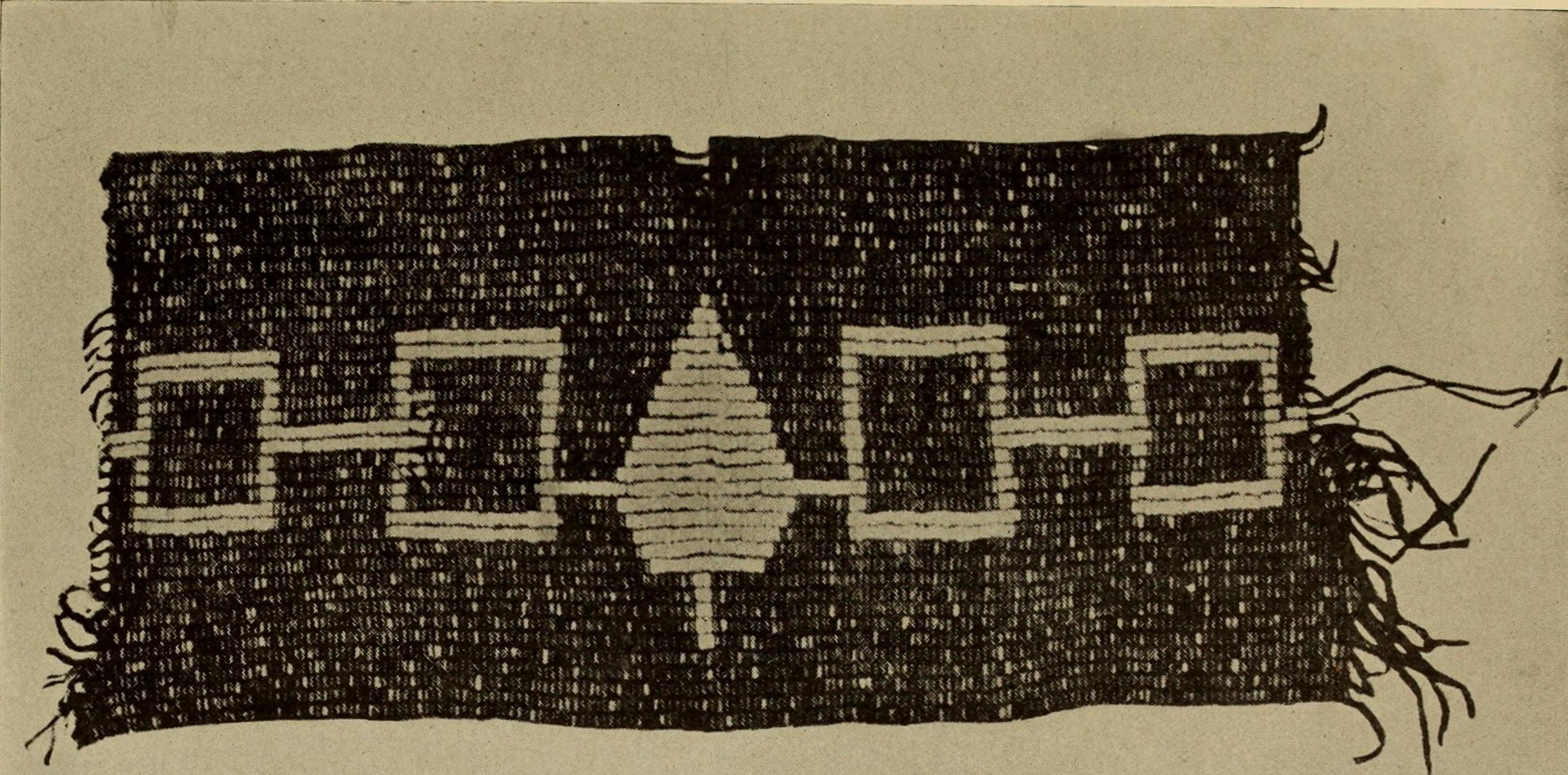
The Great Law of Peace (Gayanashagowa) is the founding constitution of the Haudenosaunee Confederacy, a political union of five (later six) nations formed in what is now the northeastern United States and southeastern Canada, estimated to date from the twelfth to fifteenth century. It is notable here for two structural features. First, it separates the authority to name a chief (held by the clan mothers), the authority to act as a chief (held by the sachems), and the authority to remove a chief (held collectively, through a formal warning process). No individual can grant, exercise, and revoke the same authority. Second, decisions of the Grand Council require deliberation across the constituent nations before a binding conclusion is announced.
These two features — three-way separation of grant, exercise, and revoke, and staged deliberation with a defined close — reappear below as the escrow trio and the firekeeper role.
3.2 Honeybee quorum sensing
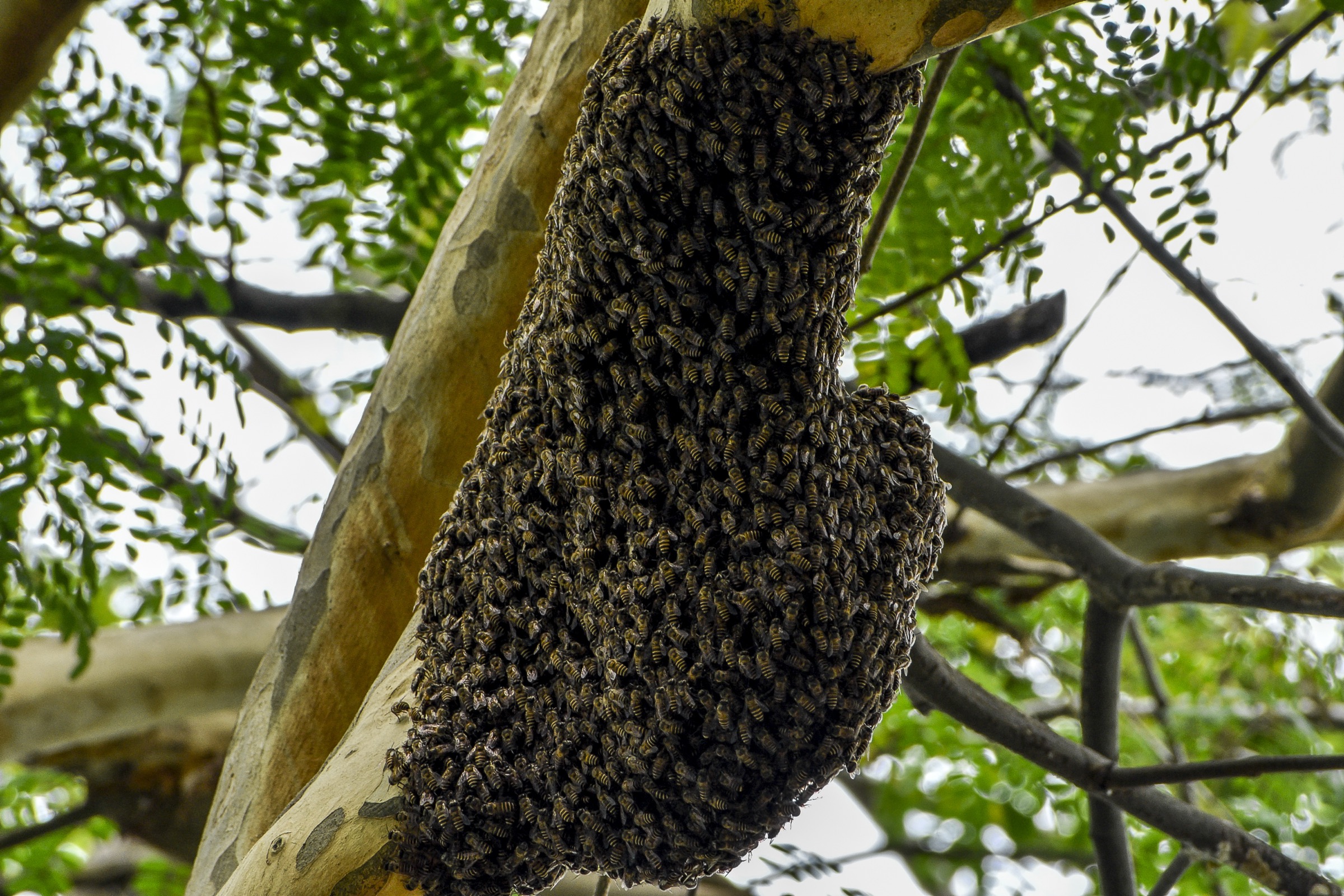
When a honeybee colony reproduces, roughly half the workers leave with the old queen and cluster on a branch. Scout bees search for a new cavity and return to advertise candidate sites with a waggle dance whose vigor tracks the scout's assessment of the site. Sites are not compared centrally. Instead, scouts recruit others to visit the sites they advertised, and the population advertising each site shifts over time. When the number of scouts at a single site crosses a threshold — a quorum — the swarm commits and departs.
Seeley's fieldwork, and subsequent modeling by Couzin and collaborators, established two properties directly relevant here. First, cross-inhibition between rival sites is essential: bees advertising one site actively discourage bees advertising rivals, which prevents a symmetric split from silently persisting. Second, the quorum response is sigmoidal in the recruited population, not a simple majority, producing sharp collective commitment once a threshold is passed. Both reappear in the quorum engine.
3.3 Stigmergy

Grassé coined stigmergy in 1959 to describe how termite workers coordinate mound construction without direct communication or central planning. Each termite deposits soil in response to the local state of the structure, and its deposit becomes a signal shaping the next termite's action. There is no plan and no coordinator; the plan is the mound.
Stigmergy was later formalized in computer science as the blackboard architecture: a shared, structured medium onto which agents post typed contributions and from which they read the current state of the problem. Here, the blackboard is a set of typed marks — proposal, endorse, inhibit, evidence — posted by agents and aggregated by a daemon. Agents do not message one another. They post marks; the daemon computes an aggregate; each agent's next turn receives a bounded projection of the current field.
3.4 Buridan's Principle
Lamport's Buridan's Principle states, roughly, that no bounded-time discrete decision procedure can always produce a definite output for a continuously-varying input; there is always some input configuration for which the procedure fails to decide within its time budget. Applied to a group decision, symmetric options can produce arbitrarily long deadlock under any purely local convergence rule. Any system that must terminate under all inputs therefore requires an explicit tie-breaking mechanism external to the local dynamics. This reappears as a hard deadline and a seeded tie-break.
4. Design premise
The starting observation is that most documented failure modes of non-hierarchical human organizations — trust manufacturing, bounded attention, ego, career incentives, mortality — are properties of humans, not of coordination itself. Language-model agents do not carry those constraints. This does not mean flat agent coordination will succeed where flat human organizations have failed; it means the constraints that must be built into the substrate are different, and shorter.
Three constraints do survive the transfer. They are properties of coordination rather than of humans, and any leaderless design must address them explicitly.
Symmetric-option deadlock. Two roughly equal options can persist without resolution unless a mechanism either forces asymmetry (cross-inhibition) or terminates the deliberation regardless of state (a deadline).
Accountability dissolution. In a fully diffuse decision, no one signs the outcome. There is a formal result — Zamboni and Kalampakas's elected-dictatorship theorem — showing that a diffusion-free assignment of responsibility requires a single distinguished decider. This design supplies one, but with the crucial constraint that it cannot decide, only ratify.
Sybil capture. For agents, creating additional agents is essentially free. Any coordination scheme that weights by contributor count is trivially attacked. The counterweight is credential-weighted quorum combined with weight-splitting on spawn.
5. The three primitives
Stigmergy. Agents do not communicate directly. They post typed marks to a daemon-owned blackboard, and each agent's next turn receives a bounded, decayed projection of the current field. This removes agent-to-agent message channels as an attack surface, bounds the token cost of context because stale marks fade, and makes the blackboard state fully inspectable.
Subsidiarity. Most agent turns do not need to convene a council. A council is convened only when the action is shared-state, irreversible, or cross-boundary. Cheap, reversible work stays local and pays no quorum cost.
Authority-in-escrow. The right to grant a title, the right to exercise it, and the right to revoke it are split across three mechanisms: a title registry that holds tokens at rest, the working agent that may hold and act on a title but cannot mint or transfer it, and a revoker that can cancel a turn and return the title to escrow but cannot itself hold one. No participant can grant, exercise, and revoke the same authority. Every guardrail is enforced by the daemon, not by a language model.
6. The quorum engine
Convergence is decided by a pure engine that contains no model logic and takes time as an explicit argument. Models produce marks; the engine counts them. It implements four numerical properties, each independently testable.
6.1 Credential-weighted tallies
Each agent contributes one live stance across the entire field. Posting a new stance replaces any prior stance from the same agent on any other proposal. A chatty agent that posts one hundred endorsements still counts as one credential's worth. For agents and proposals , let denote agent 's current stance on proposal , with the invariant
6.2 Time decay
A mark's effective weight decays exponentially with the time since it was posted. Let denote the half-life. A mark posted at time with initial weight has effective weight at time of
A stale mark that nobody re-asserts fades toward zero, which prevents an agent from holding the field by shouting once and going silent.
6.3 Cross-inhibition
Endorsement adds weight; inhibition subtracts weight. Combined with the single-live-stance invariant, this produces active suppression between rival proposals rather than passive coexistence. The net weight of proposal at time is
where is the credential weight of agent and is the timestamp of 's current stance on .
6.4 Threshold gating
The engine supports two convergence rules. Under the net-weight rule, convergence fires when
where and are the leader and runner-up, is the cutoff, and is the required margin. Under the sigmoid rule — following the Couzin quorum response — convergence fires when
where
with midpoint and steepness . In both rules, the margin requirement is what makes cross-inhibition bite: two near-equal rivals never satisfy it.
7. The two-round convene protocol
The convening flow runs a two-round blackboard protocol. In the first round, each worker receives the question and posts one proposal mark. In the second round, each worker receives a bounded projection of the current field and posts either an endorse or an inhibit mark. After every mark, the quorum engine re-tallies and emits an update event. When the engine reports convergence — or when the topic hits its deadline — the daemon emits a single binding Converged (or Aborted) event followed by TopicClosed. The engine, not a language model, decides when quorum is met.
8. The trust boundary
The role that ratifies convergence is the firekeeper. It is a per-topic title, not a standing chair, and its only power is to emit the binding Converged event. The daemon rejects that call unless its own quorum state already reports convergence. The firekeeper can ratify but cannot override.
Proof of title uses a decision token drawn from a cryptographically secure pseudo-random source (approximately 244 bits of entropy) and compared in constant time. The raw token is never stored; the registry persists only a salted SHA-256 verifier, in the same way a well-designed password store persists only a hash. This makes the firekeeper's right to close a topic unforgeable — both against a forged claim from a non-firekeeper and against inspection of the persisted registry.
9. Sybil defense
Cheap duplication is the natural attack against credential-weighted quorum, because spawning additional agents is close to free. Three mitigations are applied jointly.
Credentials, not messages. Weight accrues to an agent's credential, not to each mark. One agent posting one hundred endorsements contributes one credential's worth of weight, per the invariant in §6.1.
Weight-splitting on spawn. When an agent spawns children, the parent's quorum weight is divided among the children rather than duplicated. If agent with weight spawns children , the daemon enforces
Forking a clone army to fake consensus produces the same total weight as one agent.
No self-renewal. No role can name its own successor. The authority that issues titles cannot hold, transfer, or renew them. This blocks the classical attack where an agent renews its own credential and gradually accumulates weight.
The honest limit: this defends against cheap duplication, not against coordinated collusion among a set of legitimately credentialed agents that all agree to vote the same way. That case is left to detection (anomaly flagging on vote synchrony), not prevention.
10. Termination guarantees
Every guardrail below is enforced by the daemon, not by a language model.
| Rule | Mechanism | Purpose |
|---|---|---|
| T1 | Hard deadline per topic | Buridan escape: force resolution regardless of vote state |
| T2 | Cross-inhibition, size-scaled | Symmetric splits cannot silently persist |
| T3 | Time decay of marks | No agent holds the field by shouting once and going silent |
| T4 | Quorum threshold, not unanimity | Unanimity reserved for the safety domain |
| T5 | Single signed terminator | Satisfies the accountability result |
| T6 | Graduated-then-hard recall | Removal proceeds through defined stages |
| T7 | Token-budget ceiling | Forced abort at current leader if budget exhausted |
At the deadline, if there is a clear leader, the engine converges on it. If there is a true tie, the topic aborts with a Split reason, or is resolved by a seeded tie-break under configuration.
11. Open questions
The design guarantees that a topic terminates with a signed, bounded-cost outcome. It does not guarantee that the outcome is good. A quorum of mediocre agents will converge on mediocrity, quickly and accountably. Whether leaderless stigmergic convergence produces judgment comparable in quality to a chair-mediated council is an empirical question, and the reason this design is worth building rather than only arguing about.
A second question concerns cross-daemon federation. A single daemon per instance is assumed throughout. A federation — where a topic in one instance can request a convening in a peer instance and integrate the peer's convergence into its own — is a natural extension, but introduces trust and synchronization concerns the single-daemon design does not have to solve. This is deferred.
A third concerns the immutable decision log. The accountability result of §4 requires that who signed what persist in an append-only record, even after individual marks have decayed out of active tallies. Persisting titles and outcomes is straightforward; a full signed decision log covering every ratified convergence is planned but not yet specified.
12. Prior art
- Great Law of Peace (Gayanashagowa). Haudenosaunee Confederacy oral constitution, twelfth–fifteenth century.
- Seeley, T. D. (2010). Honeybee Democracy. Princeton University Press.
- Couzin, I. D. et al. (2011). "Uninformed individuals promote democratic consensus in animal groups." Science, 334(6062).
- Grassé, P.-P. (1959). "La reconstruction du nid et les coordinations interindividuelles chez Bellicositermes natalensis et Cubitermes sp. La théorie de la stigmergie." Insectes Sociaux, 6.
- Parunak, H. V. D. (2006). "A survey of environments and mechanisms for human-human stigmergy." E4MAS.
- Erman, L. D., Hayes-Roth, F., Lesser, V. R., Reddy, D. R. (1980). "The Hearsay-II Speech-Understanding System." ACM Computing Surveys, 12(2).
- Hayes-Roth, B. (1985). "A blackboard architecture for control." Artificial Intelligence, 26.
- Lamport, L. (1984, revised 2012). "Buridan's Principle." Foundations of Physics, 42.
- Zamboni, R. and Kalampakas, A. (2025). "An elected-dictatorship theorem for diffusion-free responsibility assignment." arXiv:2506.07935.
- Robertson, B. J. (2015). Holacracy. Henry Holt.